There are those rare moments when a place aligns so precisely with an idea you have carried for years that it feels less like discovery and more like recognition.
For me, Stanglwirt was that place.
When I co-founded a small, independent green spa magazine in 2006, I had a very specific vision in mind—one that extended beyond the early language of “eco” and “organic” just beginning to surface in the industry. I imagined a fully integrated system: a spa not as an amenity, but as an ecosystem—where architecture, agriculture, energy, water, and wellness were inextricably linked. And I went in search of those places.
Nearly two decades later, in a quiet valley in the Tyrolean Alps, I found one that brought it all together beautifully.
Stanglwirt is not simply sustainable. It is a closed-loop philosophy brought to life—a 400-year-old, family-run estate that has evolved into one of the most sophisticated examples of regenerative hospitality in the world.

The Hauser family, from left to right: Maria, the firstborn, with her parents, Balthasar and Magdalena, and her siblings, Elizabeth and Johannes.
For more than three centuries, the Hauser family has remained the quiet force behind Stanglwirt—not as distant owners, but as stewards of a living place. What began as a Tyrolean inn and farm has, over four generations, been shaped with uncommon clarity of purpose into a resort that still feels grounded in its origins. The land is not a backdrop but an active participant; the rhythms of farming, hospitality, and family life are intertwined. You sense it not in grand gestures, but in the continuity—in the way tradition is neither preserved for show nor abandoned for progress, but quietly carried forward.
Conversations with Maria Hauser reveal a philosophy not of expansion, but of stewardship—a careful evolution of the property without compromising its core. Here, past and future are not in tension; they exist in quiet dialogue. When considering the wellness word du jour, “longevity,” Hauser and her team instead arrived at a more fitting expression: “Bio Harmony.”
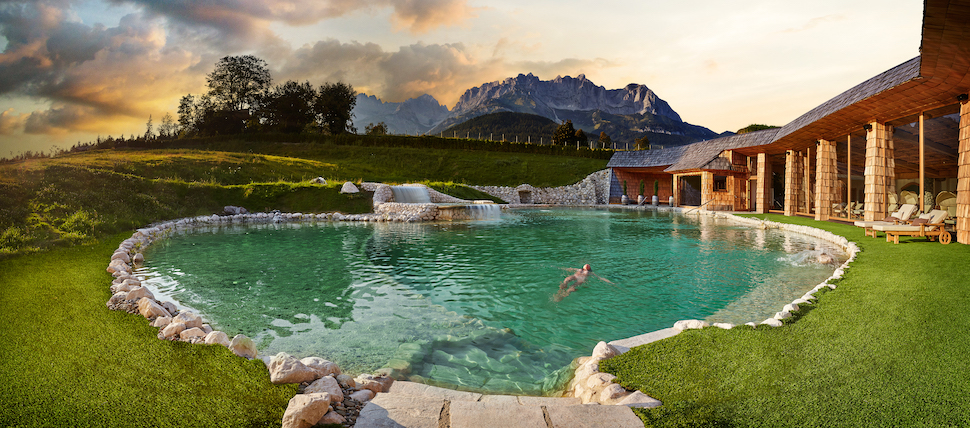
The property is home to a 160-acre working farm that underpins a true farm-to-table culinary program, as well as a renowned riding school centered on its Lipizzan horses. Each morning, I stepped onto my terrace to breathe in the brisk Alpine air and bask in the rugged drama of the Wilder Kaiser range. From this vantage, I watched the storied Lipizzans grazing contentedly.
My comfortable suite, one of 170 spacious rooms, was refreshingly simple and chic. The hotel meets the highest sustainability standards ensured throughout. For example, locally sourced materials such as the Arolla pine are extensively used; no steel girders are used in the ceilings but only wooden beams, all wooden bricks are bonded using lime mortar instead of cement, and room fittings include exclusively solid-wood furniture, antibacterial floors made of local mountain larch and organic straw-filled couches. All the mattresses are specially manufactured and consist of natural rubber, cotton, sheep’s wool, and horsehair.
When considering the wellness word du jour, “longevity,” Maria Hauser and her team instead arrived at a more fitting expression: “Bio Harmony.”
Sustainability as Infrastructure
At Stanglwirt, sustainability is not positioned as an initiative. It is the operating system.
Built according to the principles of baubiologie—a German approach to construction that prioritizes human health, natural materials, and environmental harmony, the property reflects a deep commitment to biological integrity.
Water flows from the resort’s own Kaiser spring, supplying drinking water, pools, and spa facilities, while advanced systems ensure that resources are continuously reused and repurposed.
Most notably, a newly introduced bioenergy power plant converts regional wood chips into electricity, heat, and biochar—creating a circular energy system that reduces emissions while contributing to soil health and long-term carbon storage.
This is sustainability not as statement, but as structure—quiet, comprehensive, and deeply embedded.
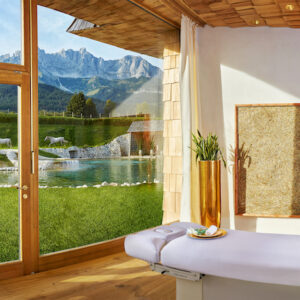
A serene treatment space
The Spa & Wellness Landscape
The expansive 130,000-square-foot spa and wellness complex features five saunas, three steam baths, and a Water World anchored by Europe’s largest saltwater pool—alongside a lively children’s area with a poolside movie theater and an exhilarating waterslide. Under the direction of Spa Manager Julia Ressler, the spa is supported by a team of 30 highly trained professionals.
The spa is experienced not as a single destination, but as a landscape—one that unfolds gradually through heat, scent, and atmosphere.
The Kaiser sauna anchors the experience with sweeping views of the Wilder Kaiser mountains. The pine sauna offers a softer, restorative heat, infused with the scent of locally sourced wood known to calm the nervous system. The stone sauna radiates gentle warmth from sandstone, easing joints and back, while the organic spruce sauna evokes the intimacy of a forest hut—one of the most transportive spaces I encountered.
Beyond the dry heat, steam and mineral experiences—particularly the salt steam grotto and marble steam bath—extend the ritual into moisture and breath. Cold plunges and Kneipp pathways provide a bracing counterpoint to the heat, stimulating circulation and sharpening awareness, while the surrounding indoor and outdoor pools—each offering a distinct temperature and perspective—encourage a fluid progression through the space. Here, the experience becomes cyclical rather than linear, a quiet dialogue between warmth, water, and air.
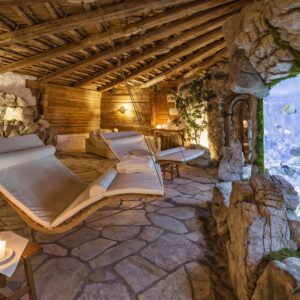
The Oasis of Stillness
The Oasis of Stillness
If the sauna landscape is about heat and movement, the relaxation spaces offer something else entirely: stillness.
The Oasis of Stillness, centered around a softly illuminated seawater aquarium, becomes an unexpected focal point—a place where time slows almost imperceptibly. Elsewhere, panoramic relaxation rooms open onto alpine views, quiet lounges are anchored by firelight, and indoor and outdoor repose spaces, oriented to water and mountain views, invite lingering without purpose.
I spent hours here—moving, pausing, returning—never once feeling the need to rush.
In an era where even relaxation is often programmed, these rooms resist urgency. They remind you that the deepest work of a spa is not in what it adds, but in what it allows to fall away.
And for those moments when one doesn’t feel like being still, Stanglwirt offers an array of wonderful experiences: an indoor fitness garden encompassing a full gym, ski and snowboard school, 14 tennis courts with academy, and a horseback riding program.

Rock bath with waterfall
Water as System and Sensation
Water, at Stanglwirt, is both experience and infrastructure.
The spa’s water worlds—brine pools, natural swimming lake, rock pools, waterfall grotto, and a 25-meter competition pool—offer a spectrum of immersion, from restorative to invigorating.
But what distinguishes them is their source.
Every pool, every bath, every immersion is fed by the resort’s own Kaiser spring, part of a broader groundwater system that supports both the guest experience and the resort’s energy infrastructure. Through advanced heat pump technology, this same water is used to heat the property—saving significant energy—before being cooled and reused elsewhere.
It is a seamless, circular system. And you feel it.
I spent a considerable amount of time in the Kneipp grotto, which offers one of the simplest—and most effective—experiences of the spa. Moving slowly through cold water, in the traditional “stork step,” circulation is stimulated, the body reawakens, and the senses sharpen. It is a reminder that wellness need not be complex to be profound.
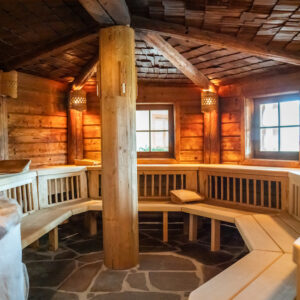
The WIlder Kaiser Sauna
The Human Touch
Treatments at Stanglwirt reflect the same depth of intention.
A Rolfing session with biomechanical therapist Sascha Bauer brought measurable relief to a long-standing neck issue, while the Alpine Milkshake body treatment—performed by the warm and nurturing Michaela and rich with goat butter and oils—connected the experience directly back to the land.
The Kaiser Massage with Matthias, tailored through consultation, and a facial using the resort’s in-house TGC (The Good Conscience) skincare line reinforced a philosophy of individualized, integrity-driven care—brought to life by Theresa, an esthetician with truly gifted hands.
Additionally, as part of the spa’s 2019 expansion, Stanglwirt introduced a dedicated Dr. Barbara Sturm treatment suite—her first collaboration with a hotel—an addition that reads less as a directional shift and more as a thoughtful layering, where modern, results-driven skincare is integrated into the resort’s deeply rooted Alpine wellness philosophy. This past September, the spa expanded that partnership with the launch of a Barbara Sturm Masterclass.
Grounding the Future
There is a tendency, in today’s wellness landscape, to look forward—to the next innovation, the next technology, the next idea.
Stanglwirt suggests something else.
That the future of spa may, in fact, lie in a deeper return—to systems that are integrated, to materials that are honest, to practices that honor both body and land.
I left with a renewed understanding of what sustainable spa can be—not as concept, but as reality. And with the quiet recognition that, in many ways, this model has already been here all along.

Mary Bemis
Mary Bemis is Founder & Editorial Director of InsidersGuidetoSpas.com. An advocate for all things spa, Mary forged a vocabulary for spa reportage that is widely used by those who cover the issues today. Recently honored as a Top 30 Influential Voice Transforming Wellness by Medika Life, Mary is an inaugural honoree of Folio’s Top Women in Media Award. Her spa media roots run deep—in 1997, she launched American Spa magazine, in 2007, she co-founded Organic Spa magazine, and in between serving on the ISPA and NYSPA Board of Directors, she was on the launch teams of Luxury SpaFinder and New Beauty magazines. Named a "Wonder Woman of Wellness" by American Spa magazine, Mary was honored by the International Spa Association with the distinguished ISPA Dedicated Contributor Award. She is a special advisor to the non-profit Global Wellness Day.
- Web |
- More Posts(91)