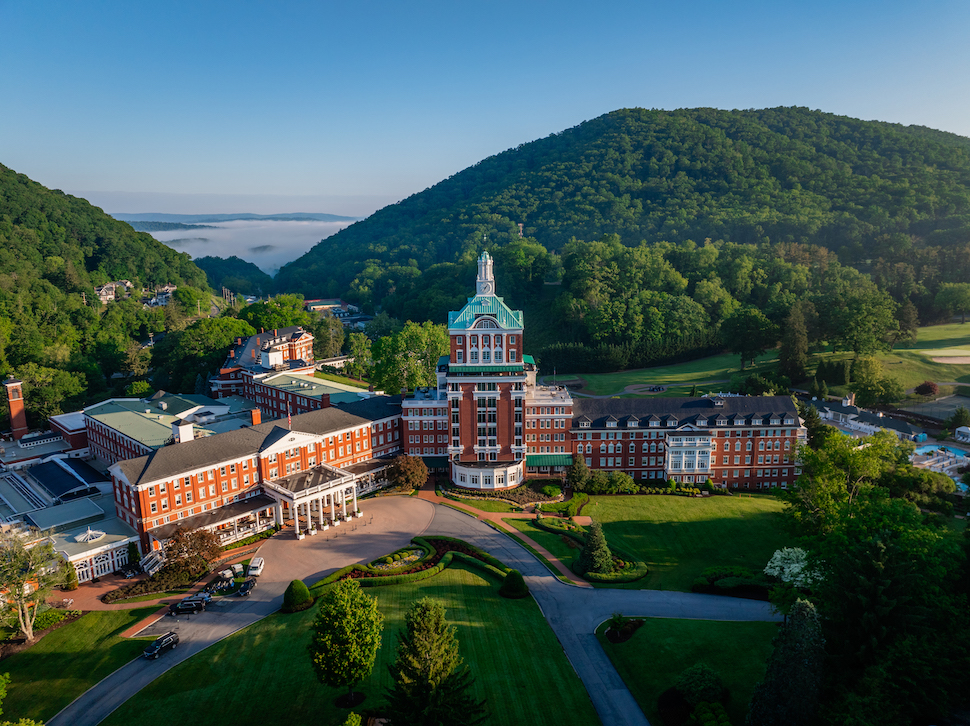
There’s a magic about grand old destination spas, resorts with history that spans centuries. On a recent visit to The Omni Homestead Resort & Spa—“America’s First Resort”—in Hot Springs, Virginia, that magic was in full force. I’ve visited this historic hotel in the heart of the Allegheny Mountains across several decades and under several owners. Each time I’ve arrived, I felt a wonderful, oddly familiar sensation: I’m not just stepping into a grand resort, I’m stepping into a living archive of American history and spa culture.
You can sense a change in the air when you wind into this quiet corner of Bath County, Virginia. The mountains stretch wider, the roads quiet, the pace shifts. By the time you reach the long, tree-lined approach to the stately red brick main building, you feel it—a subtle but very real charge from the ancient pools and all the generations drawn to the the classic custom of “taking the waters.”
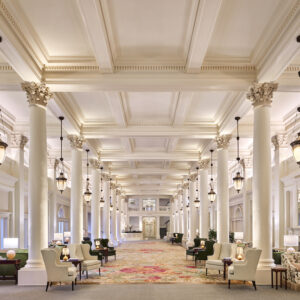
The grand Great Hall
I come to this place with a long view of America’s spa lineage—one informed by years spent researching the country’s original spa towns, including neighboring Berkeley Springs, West Virginia, which calls itself America’s First Spa. If Berkeley Springs—first known as Bath—is where the North American spa story formally begins, then The Homestead is where it first matured: Where wellness, hospitality, and the restorative powers of mineral water blossomed into a grand American resort.
On my recent visit, on a brisk autumn day, I sense something shifting again. The property feels alive and vibrant in a way I haven’t experienced in years. It is as though The Homestead—after a long chapter of “suspended animation,” as Managing Director Mark Spadoni describes it—is remembering itself—the very best version of itself.
This is the story of that reawakening.
The Long Lineage of American Waters
Let us always remember that the first spas in North America are Indigenous. Thousands of years before the first bathhouses and resorts and the carriage roads and railroads that brought European Americans to experience them, the Indigenous peoples created trails to the mineral springs for ceremony, healing, and rest. And long before the word “spa” entered the American vocabulary, colonial settlers flocked to natural warm springs wherever they could find them.
The earliest physical infrastructure on the site that would become The Homestead was a stone basin constructed around one of the primary springs about 1761. A few years later, a militia commander from the French and Indian War named Captain Thomas Bullitt was awarded 300 acres around the springs for his service, and he spent the next couple of years building an 18-room log inn just steps from the stone basin. That simple lodge marked the first attempt to welcome travelers to these healing waters and established the Homestead’s claim as Americas First Resort.
If there is a single act that symbolizes The Omni Homestead’s new era, it is the meticulous restoration of the Warm Springs Pools.
In the decades that followed, modest bathing structures gave way to more formal bathhouses. By the late 18th century, “taking the waters” became a distinct “springs culture” that took hold and spa-goers visited the warm and cold springs of Virginia and West Virginia—each with its own mineral profile, each believed to soothe a particular ailment. I’ve walked these landscapes, studied their histories, and spoken to their keepers, and have found a profound continuity among them. Yet each springs town has its own character, its own mythology, its own way of holding people.
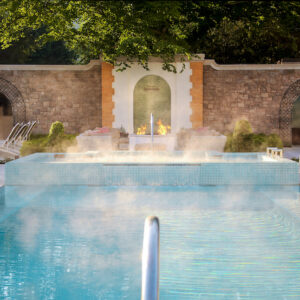
The serene spa pool
The Homestead’s recognizable architecture emerged much later. After a devastating fire in 1901, M.E. Ingalls and his partners turned to the Cincinnati architects Elzner & Anderson, who in 1902 created the stately red-brick Georgian Revival structure that still defines the Homestead’s silhouette. Over the next decade, the architects returned to add the West and East wings, introducing Colonial Revival influences while preserving the property’s coherence and grandeur. The result is the Homestead we know today: a place shaped as much by architectural vision as by the enduring pull of mineral water. Despite modern distractions and shifting trends, the Homestead’s essential purpose remains remarkably intact.
Suspended Animation: A Grand Dame Pauses
When Mark Spadoni arrived at the Homestead after a lengthy career overseeing world-class spa and wellness operations across Hawaii, Hilton Head, Savannah, and beyond, he found a property with a storied past—but one searching for its next chapter.
“In the ’60s and ’70s, this was a five-star, five-diamond resort,” he tells me. “But after that era, through various ownership changes, the question became: what comes next? It wasn’t lost—just trying to figure out the next chapter.”
One of those chapters, of course, included its partnership with Canyon Ranch, which debuted a gleaming new 60,000-square-foot facility complete with a state-of-the-art thermal suite in June of 2013. I visited during that period, taking in the newly completed spa and thermal suites, and something just didn’t feel right. When Omni acquired the Homestead from KSL that same year, the company moved quickly. By December, the Canyon Ranch partnership ended. Omni, Spadoni says, “always believed the spa had the opportunity to stand on its own legs.”
For nearly a decade, the resort existed in a state of limbo—neither fully historic nor fully renewed, waiting for the clarity of a long-term vision. That clarity arrived with the completion of an $170 million restoration not just to refresh the resort from guest rooms to gathering spaces but also one of the most impressive—and culturally significant—spa restoration efforts in the country. I studied this restoration through interviews, architectural reports, and years of following the project’s evolution. If there is a single act that symbolizes the Homestead’s new era, it is the meticulous restoration of the Warm Springs Pools.
A Resurrection Through Wood and Water
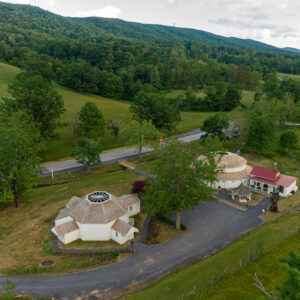
The Warm Springs Pools; photo by Gordon Gregory
The process began in earnest in 2015, when the Homestead and Omni formed the Bathhouses Advisory Committee, a formidable assembly of historians, preservationists, architects, and experts from the Virginia Department of Historic Resources, Preservation Virginia, and the University of Virginia. Their task: develop a comprehensive Historic Structures Report documenting the bathhouses’ past and outlining a blueprint for their future.
“This wasn’t just a renovation project,” shares Lynn Swann, Director of Marketing and Communications, who has been with the property for 14 years. “It was one of the most complex historic preservation efforts in the region—years of research, debate, and care from people who were truly passionate about these bathhouses.”
In 2017, Bath County closed the bathhouses due to safety concerns. By then, the report was complete, but Omni was still charting the resort’s broader renovation. Momentum paused—until 2021, when Omni made the commitment to move forward.
“When the county deemed the bathhouses unsafe in 2017, it was heartbreaking. But it also marked the moment when everyone realized how vital these structures were—and how urgently they needed a thoughtful, historically accurate plan,” explains Swann.
Working with 3North architects and Lionberger Construction, the team selected the 1920s as the period of significance. Anything original to that era would remain; anything added later would be removed. This required extraordinary craftsmanship and restraint. The wooden fabric of the buildings—the 22-sided Ladies’ Bathhouse and the octagonal Gentlemen’s Bathhouse—was preserved down to the board.
“Our goal was to save every piece of historic fabric we possibly could. If a ten-foot board had two feet of damage, we cut away only those two feet and saved the remaining eight. That level of detail guided everything,” said Swann.
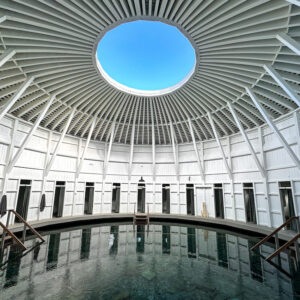
The Ladies Bathhouse at the Warm Springs Pools; photo by Gordon Gregory
They removed the central support pole in the Ladies’ Bathhouse, revealing the oculus as it would have appeared a century ago. They preserved the curtained dressing stalls. They honored the building’s elemental honesty: unheated, unvarnished, fundamentally simple.
And importantly, they restored the bathhouses’ original name: the Warm Springs Pools.
Shares Swann, “Returning to the name Warm Springs Pools was absolutely the right thing to do. Jefferson soaked here, yes—but the name ‘Jefferson Pools’ was a 1990s invention. The historic name honors the true lineage.”
The opening was celebrated in frigid weather—ice outside, steam inside—80 people gathered in the Ladies’ Bathhouse for the ribbon cutting. A perfect convergence of past and present.
“We opened the Warm Springs Pools on December 17, 2022. It was freezing—an ice storm, steam everywhere—yet the Ladies’ Bathhouse was filled with people standing shoulder to shoulder,” recalls Swann. “After everything, to see that was incredible.”
When you stand inside those pools now, listening to the echo of water against ancient timbers, it’s hard not to feel the weight of centuries. In our world of speed and distraction, this is a place designed for stillness and for breath.
Inside the Spa: Stewardship, Spirit, and the Work of Care
“The Homestead has a spirit you simply cannot manufacture,” Spa Director Audrey Zmigrodski tells me. “Guests feel it the moment they arrive.”
Her role, as she sees it, is one of stewardship—of history, of energy, of team.
“Every decision must support the space, the guest experience, and the traditions we’re carrying forward,” she says. Many associates have been here 20, 30, even 40 years. They are the keepers of memory.”
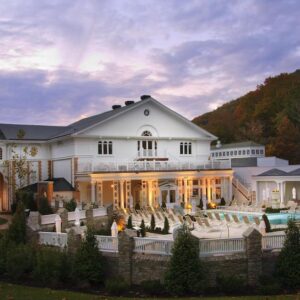
Exterior of the spa and Serenity Garden
Her most popular treatment is the Homestead Holistic Massage, followed closely by the Personalized Prescriptive Facial, which uses the German skincare line Babor. Their signature massage oil blend—arnica, sage, lavender, mint, and rosewood—is created in partnership with Make Scents.
The Serenity Garden remains a guest favorite, with its warm mineral pool, reflexology walk, and invigorating deluge shower. The Aqua Thermal Suites, with their heat-cool-relaxation circuit, serve as a transitional ritual—“a way to let guests step out of daily life and into intention,” Zmigrodski notes.
The thermal circuit itself is thoughtfully sequenced—a modern interpretation of ancient bathing traditions. A gentle rise into aromatic steam, a cool awakening beneath experiential showers, the radiant warmth of the herbal cocoon, and the crisp clarity of a cold-air chamber all work together in a rhythmic cycle of heat, cold, and rest. It is contrast therapy made elegant: a way of engaging the body’s natural intelligence, restoring equilibrium, and preparing guests to move more intentionally through the rest of their spa experience.
Zmigrodski’s leadership philosophy includes a practice she describes as “wasting time”—spending a few minutes each day connecting with staff outside of work talk.
“It builds trust,” she says. “And when your team feels seen and supported, the guest feels it.”
In an era when wellness can feel fast and commodified, The Omni Homestead offers something far rarer: a reminder that true spa culture is timeless.
A Wider Definition of Wellness
The Omni Homestead’s wellness story now extends beyond the spa walls. Spadoni describes a community-wide vision involving Bath County’s clean mountain air, slower pace, and natural beauty.
“Wellness is not confined to the resort,” he emphasizes. “It’s emotional, social, intellectual. It’s adventure, learning, and connection.”
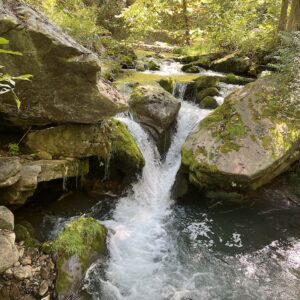
One of the 13 waterfalls on the Cascades Gorge Hike
Spadoni has implemented a variety of impressive programs like the spectacular Cascades Gorge Hike that embody this philosophy—an hour-long guided immersion into flora, fauna, and the power of 13 waterfalls. Posings & Pairings is an unusually fun combination of yoga and wine, led by sommelier and yoga instructor Quynh Cohen.
And the resort’s monthly Wine Experience dinners, featuring old-world-style Virginia winemakers whose lower alcohol content and food-friendly profiles echo traditional European sensibilities.
In four years, they’ve hosted 45 winemaker dinners—more than 200 unique, non-repeated dishes.
“It’s about crafting something meaningful,” he says. “Something that invites guests into curiosity.”
In a visionary move, Spadoni has also created a dedicated wellness space for Fascial Counterstrain therapy with physical therapist Jonathan Eaton with whom he is currently working on a nutritional program. The resort’s newest creation is a custom bath and body line inspired by the mineral composition of the Warm Springs Pools, developed with Veronique Paquet Dexter. The launch includes bath minerals, hand and body wash, lotion, a room mist, and a candle—each thoughtfully formulated and subtly scented with a fresh, lightly floral custom blend.
Spadoni speaks about wellness with the ease of a seasoned hospitality leader—amiable, perceptive, and grounded in decades of understanding both his guests and his craft. “I knew early from my experience in Hawaii and my Heavenly Spa experience, and also up here that when I’m able to focus on spa and open to wellness, my heart beats a little faster because I know at the end of day we’re onto something that can make a difference in our society.”
The Homestead Remembers Itself
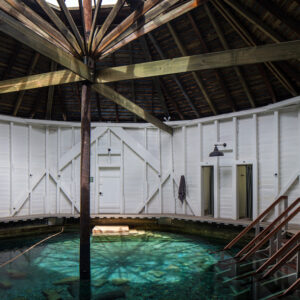
The welcoming waters of the Warm Springs Pools; photo by Gordon Gregory
I ended my visit with a morning soak in the Warm Springs Pools. It was quiet and emotional—an experience that felt both intimate and ancient—and one that I had long looked forward to. I stepped in slowly, noticing the stones glinting beneath the surface and the steam hovering just above the water, as if inviting me to cross a threshold. The timbers—dark, fragrant, alive with history—creaked softly as I stepped down into the circular pool. I walked the circumference, following the drifting shadows of sun and water. I soaked and floated. I absorbed the stillness. The white curtains of the simple dressing stalls stirred faintly in the light. And then the sun poured through the oculus, illuminating the pool in a way that made the water feel newly awake. The water brightened and lifted—it felt happy, as though it were remembering itself.
The Omni Homestead is not reinventing itself so much as returning to its origin. Its waters—like the great springs cultures of centuries past—are not simply an amenity, but the enduring thread that has defined this place for eons.
In an era when wellness can feel fast and commodified, The Omni Homestead Resort & Spa offers something far rarer: a reminder that true spa culture is timeless. That healing often begins with stillness. And that when a place remembers what it has always known, guests can remember something essential in themselves.
Here, in this quiet valley, surrounded by mountains and mineral water, the Homestead is awake again.
And the waters, as always, are waiting.

Mary Bemis
Mary Bemis is Founder & Editorial Director of InsidersGuidetoSpas.com. An advocate for all things spa, Mary forged a vocabulary for spa reportage that is widely used by those who cover the issues today. Recently honored as a Top 30 Influential Voice Transforming Wellness by Medika Life, Mary is an inaugural honoree of Folio’s Top Women in Media Award. Her spa media roots run deep—in 1997, she launched American Spa magazine, in 2007, she co-founded Organic Spa magazine, and in between serving on the ISPA and NYSPA Board of Directors, she was on the launch teams of Luxury SpaFinder and New Beauty magazines. Named a "Wonder Woman of Wellness" by American Spa magazine, Mary was honored by the International Spa Association with the distinguished ISPA Dedicated Contributor Award. She is a special advisor to the non-profit Global Wellness Day.
- Web |
- More Posts(91)