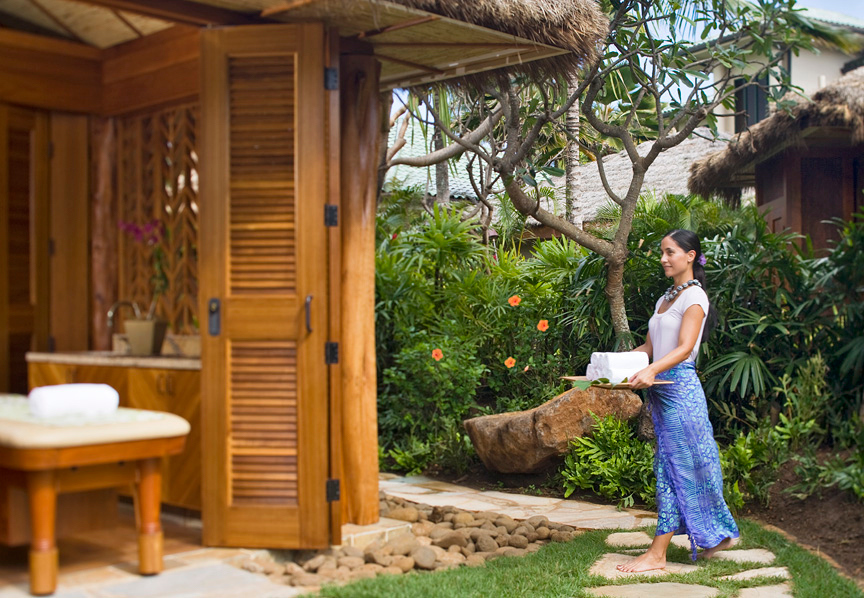
There are places that are designed to fit the landscape. And then there are places that emerge from it. You feel the latter almost immediately here on Kauai’s southern shore, in Poipu, stepping into the open-air lobby, the wind moving through, the ocean just beyond.This land was once part of a traditional ahupuaʻa—a system running from mountain to sea, where life moved in balance between field and ocean. The Grand Hyatt Kauai Resort & Spa is a continuation of that rhythm—and one of the defining resort spas of Hawaii.
Opened in 1990 and shaped to blend into the landscape (no building rising higher than a coconut tree), the resort was conceived with an unusual restraint for its time: a built environment that defers to wind, water, and view. It is this quiet discipline—and the ownership of a single family over all these years—that has allowed it to endure. Many of the staff have been here for generations and sleep in their own homes rather than in their cars, and the sense of ownership and gratitude is palpable.
And within it, the iconic Anara Spa—45,000 square feet of open-air pathways, garden hales, and lava rock—remains one of the earliest—and still one of the most fully realized—expressions of what a Hawaiian resort spa could be.
A Spa That Was Ahead of Its Time
 When renowned spa designer Sylvia Sepielli first arrived on-site in the late 1980s, the spa industry itself was still forming its identity.
“They didn’t know what they had,” she recalls. “This was 1989. We were still fighting to even be included in sales and marketing conversations.”
At the time, the spa had been conceived more as a destination spa—an ambitious idea within a large-scale resort environment, and one the industry had not yet fully learned how to support.
What emerged at Grand Hyatt Kauai was not just a spa, but a different way of thinking about what a resort spa could be. Open-air treatment rooms—now taken for granted—were, at the time, radical. So was the integration of indigenous knowledge. Sepielli speaks of early encounters with Hawaiian elders, and the permissions required even to incorporate elements like local salt into treatments.
“There wasn’t an association. There wasn’t a playbook. There were individual lineages, and you had to approach with respect.”
That ethos—of restraint, of listening, of not overreaching—became foundational. The result is a spa that, even today, feels less like a constructed concept and more like something uncovered.
The Feeling: “Auntie”
Ask Kristi Dickinson, Senior Director of Spa & Wellness, to describe the spa’s personality, and she doesn’t reach for industry language.
“It’s Auntie,” she says. “She nurtures everybody. She’s the house you go to when you need comfort . . . when you need someone to give your soul a hug.”
It’s an unusually precise description. Because what distinguishes Anara Spa is not innovation, or scale, or even its setting—though all are present. It is the emotional consistency of the place. The familiarity. The lack of pretense.
“Just come as you are,” Dickinson says. That is harder to achieve than it sounds.
My husband Stephen Kiesling, an Olympic oarsman who’s still rowing after 50 years, finds many luxury spas lifeless and uncomfortable: “temples of loneliness.” Anara wasn’t like that at all.
“I felt like a king for a day!” he enthused.
Anara remains one of the enduring reference points of resort spa.
The Work of Stewardship

Anara’s lava rock showers
When Dickinson arrived in 2022, she inherited not just a legacy, but a fracture. Post-pandemic, the spa had lost its rhythm. The menu had been stripped back. Deferred maintenance showed. More significantly, the team—many of whom had been there for decades—had lost a sense of pride.
“There was a broken-heartedness,” she says. “They knew what this place had been.”
Her work since has not been reinvention, but restoration. Layer by layer: rebuilding trust, re-engaging staff with cultural purpose, reinvesting in the physical space, reconnecting the team to the land.
The results are telling. In 2023, the spa was named the #1 Hyatt Spa in North America. But more importantly, more than half the team has been there 15 years or longer. Some more than 30. That continuity is not accidental. It reflects an ownership culture—rooted in the Japanese Takanaka family—that invests in people as much as place.
Watching Dickinson move through the spa—greeting long-tenured staff by name, checking in, adjusting—her role becomes clear. Not to reinvent the space, but to hold it steady.
Culture as Lived Practice
One of the most meaningful shifts under Dickinson’s leadership has been a renewed engagement with Hawaiian cultural practice—not as performance, but as internal orientation. Working with local cultural practitioner Sean Chun, the team spent months studying language, values, and foundational concepts like pono (rightness, balance) and mana(energy).
“The guest may never understand the difference,” Dickinson says. “But the provider does. And that changes everything.”
It is a subtle recalibration—but a profound one. The spa experience becomes less about technique, more about presence. Less about choreography, more about intention.
Treatments unfold in much the same way. Not as performance, but as extension of place. In an open-air hale, surrounded by garden and water, the experience feels less contained—less like a service, more like a continuation of the landscape itself.
Why It Still Works

The couples’ massage hale
By every modern metric, Anara Spa should feel dated. And yet, it doesn’t. The spa hasn’t aged. The industry has simply reinterpreted many of the elements that were always fundamental here.
Open-air design. An indoor–outdoor flow. Nature over novelty. A deep respect for the therapist experience.
Elsewhere, these are features. Here, they are foundational.
“It’s a classic,” Sepielli says. “The places that endure—it’s not just functional. It’s internal.” Anara remains one of the enduring reference points of resort spa.
You feel it walking through the garden paths. In the quiet of the relaxation areas. In the way the space never insists. In the early morning, on a 7:30 beach walk from the resort, heading into town—past sea turtles and local families, the rhythm of the place becomes clear. Nothing is hurried. Nothing is forced. The experience unfolds in its own time.
Even in the imperfections—the lava tubs overtaken by palm roots, still waiting for their next life—there is a sense of continuity rather than decline.
A Sense of Place—Held, Not Manufactured
Kauai itself resists overdefinition. Settled by Polynesian voyagers centuries ago and shaped by successive waves of cultural exchange, it remains the least altered of the Hawaiian islands—a place where history is still visible in the land.
That tension—between preservation and development—is palpable. You feel it driving past contested sites. Hearing conversations about what may come next. And then you arrive here.
A resort that, for 35 years, has held its ground—not by expanding, but by deepening. Not by chasing the future, but by staying close to something older.
The Takeaway
There are more modern spas. There are more elaborate ones. There are those that are more technologically advanced.
But there are very few that understand, so intuitively, what spa was always meant to be: A place of return. To land. To body. To self.
And perhaps most importantly—to an experience that touches eternity.

Mary Bemis
Mary Bemis is Founder & Editorial Director of InsidersGuidetoSpas.com. An advocate for all things spa, Mary forged a vocabulary for spa reportage that is widely used by those who cover the issues today. Recently honored as a Top 30 Influential Voice Transforming Wellness by Medika Life, Mary is an inaugural honoree of Folio’s Top Women in Media Award. Her spa media roots run deep—in 1997, she launched American Spa magazine, in 2007, she co-founded Organic Spa magazine, and in between serving on the ISPA and NYSPA Board of Directors, she was on the launch teams of Luxury SpaFinder and New Beauty magazines. Named a "Wonder Woman of Wellness" by American Spa magazine, Mary was honored by the International Spa Association with the distinguished ISPA Dedicated Contributor Award. She is a special advisor to the non-profit Global Wellness Day.
- Web |
- More Posts(91)