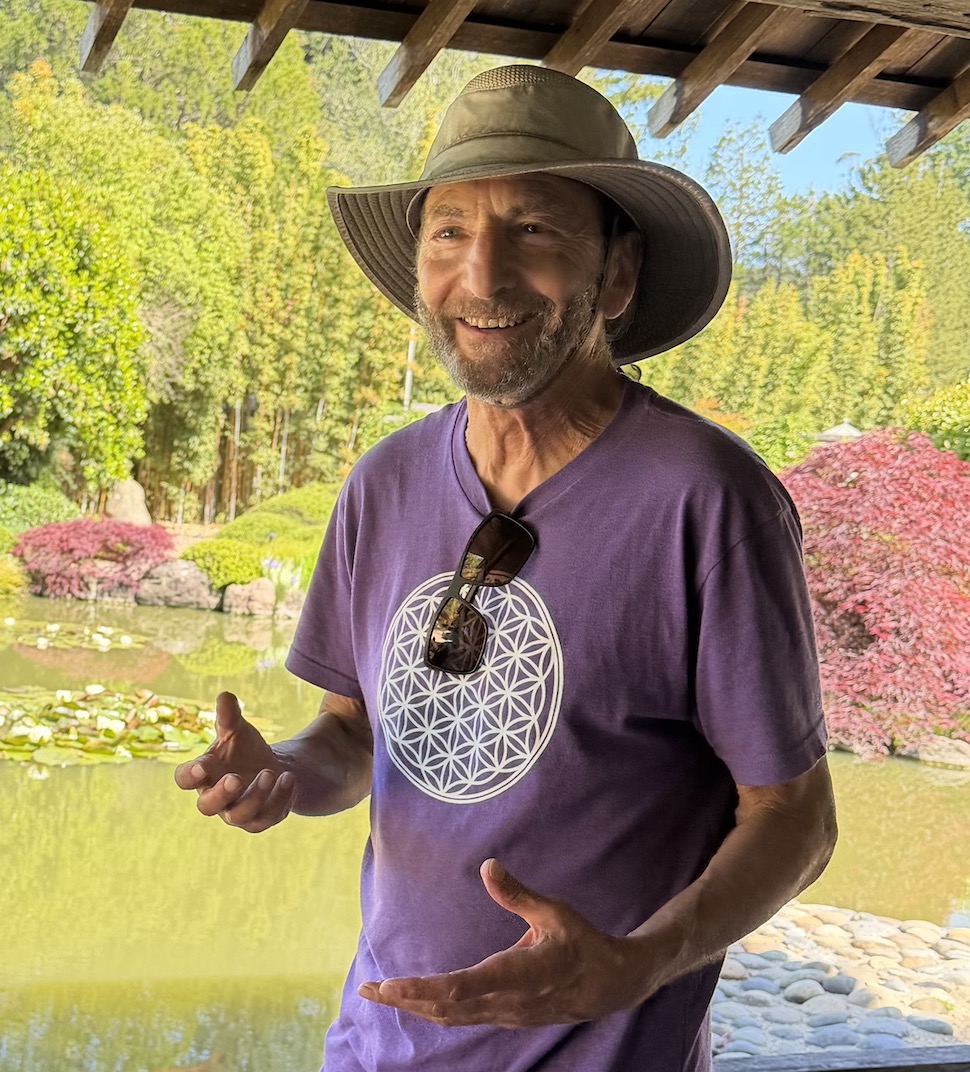
Some spa founders build successful businesses. A select few create places that transcend business altogether. For more than four decades, Michael Stusser has shaped Osmosis Day Spa Sanctuary into one of the most distinctive and beloved sanctuaries in American spa culture. Having known him for close to 30 years, it feels entirely consistent with the visionary spirit that has defined his work to learn that he has once again chosen an unconventional path.
His latest move may be his boldest yet. By placing Osmosis into a Perpetual Purpose Trust, Stusser has become the first spa owner in the United States to legally protect a spa’s mission, values, and stewardship of the land in perpetuity.
You describe this transition as protecting Osmosis from “mission drift.” What aspects of the sanctuary—or of spa culture more broadly—did you most want to safeguard for future generations through this structure?
What I most wanted to safeguard is the soul of this place. For forty years, we’ve worked to create a true sanctuary—somewhere people can step away from the noise of their lives, return to themselves, and remember they’re part of something larger. That kind of experience is surprisingly fragile. The unhurried pace, the intention behind every treatment, the relationship between guest, practitioner, and land—these are easy to talk about in a brochure and very easy to lose the moment a business is optimized for margin or scale.
It gives me great comfort to know those questions are now resolved. The Cedar Enzyme Baths, the meditation garden, the creek, the quality of presence our team brings to each guest—none of these are features to be repackaged by a future owner. They are the point. And now they’re legally protected as the point, in perpetuity.
The language around stewardship of the land, Salmon Creek, and the gardens is particularly powerful. Do you see this model as fundamentally changing the relationship between wellness businesses and the natural environments they occupy?
I hope so. The conventional model treats land as a setting—a beautiful backdrop that helps sell the service. The Purpose Trust model treats land as a stakeholder. Salmon Creek doesn’t have a vote in a typical corporation; in The Osmosis Sanctuary Trust, the health of that creek and the ecosystems it supports is written into the founding document as a responsibility we owe in perpetuity.
That’s a significant shift. It means the creek, the soil, the gardens, and the wildlife on these 5.5 acres are no longer dependent on the goodwill of whoever happens to own the business in any given decade. They’re protected by the structure itself. I think wellness businesses are uniquely positioned to model this, because we already trade on the restorative power of nature. It would be strange to profit from that relationship and not formalize our obligations to it. My hope is that more spas and retreats begin to ask: what do we actually owe the land we sit on, and how do we make that promise survive us?
Stusser has become the first spa owner in the United States to legally protect a spa’s mission, values, and stewardship of the land in perpetuity.
The spa industry has traditionally been built around founders, personalities, acquisitions, and growth models. Was there a specific moment or realization that led you to believe another path was necessary for Osmosis?

The cedar enzyme baths at Osmosis Day Spa Sanctuary
There wasn’t one dramatic moment so much as a quiet, persistent question that wouldn’t leave me alone: what happens to Osmosis after me? The conventional answers all felt wrong. Selling to a strategic buyer or private equity firm would almost certainly mean the place I spent forty years building would be optimized into something unrecognizable within a few years. Even a values-aligned successor is, in the end, just one person making choices.
My life has always been about following a heart-felt path, and the moment I encountered the Purpose Trust model—through the work of Patagonia, and the Purpose Trust Ownership Network—I knew this was the one. It felt totally right. The realization underneath it all was simple: if the mission really matters, it can’t be contingent on any single person’s character, including mine. It has to be structural. Osmosis was never really mine in any deep sense. It belongs to the land, the lineage of the practices, the guests, and the team. The trust simply makes the truth of that visible. I am very much at peace with this change. It’s a big relief, honestly—to know that all that is loved and appreciated about Osmosis can continue far into the future without disruption when my time comes.
You speak about “purpose having authority over profit.” In practical terms, how do you envision that shaping decision-making at Osmosis five, ten, or even fifty years from now?
In practical terms, it changes the question that gets asked first. In a conventional business, the opening question tends to be: will this make us more money? At Osmosis, the opening question is: does this serve our purpose—the healing of guests, the stewardship of the land, the wellbeing of our team, the integrity of our traditions? Profit is still essential; we have to be financially healthy to do any of this. But profit becomes the means, not the master.
What’s beautiful about where we’ve landed is that decisions no longer rest on one person’s instincts. We’ve moved well beyond that. Osmosis has now become a B Corporation with a board of five members who have been working together for over two years, and The Osmosis Sanctuary Trust includes a Trust Stewardship Committee whose specific responsibility is to ensure the purpose is being followed. An independent Trust Enforcer provides an additional check. So in five, ten, or fifty years, decisions about this place will be made by people accountable to a written, permanent mission—not to shareholders, not to a buyer, not to a single founder’s mood on a given day.
The baton has already been passed to Heather Bishop, who is leading Osmosis with the same passion and vision that created it. Watching her and the board carry this forward gives me enormous peace.
You are the first spa in the U.S. to take this route. What would you hope other spa founders, retreat owners, and wellness entrepreneurs begin reconsidering after hearing this story?

The beautiful Zen garden is the blossom of a lifetime of practice.
I’d hope they reconsider the assumption that the only meaningful exit is a sale. So many founders in our industry pour decades of love into a place, only to face a binary at the end: cash out or hand it off and hope. There’s a third path now, and it deserves serious thought.
More fundamentally, I’d invite my colleagues to ask what they’re actually building. Is it an asset to be liquidated, or a living institution meant to outlast them? If it’s the latter—and I suspect for many founders it quietly is—then the ownership structure should reflect that.
I can tell you from where I sit today that resolving these questions brings a kind of peace I didn’t fully anticipate. Knowing that Osmosis will go on being Osmosis, that Heather and the board are carrying it forward beautifully, that the land and the traditions are protected no matter what—that is its own form of healing.
Wellness, more than almost any other industry, claims to be about long horizons. Our businesses should be capable of matching the timescales we talk about. Whatever structure gets a founder there, the world needs more of it.

Mary Bemis
Mary Bemis is Founder & Editorial Director of InsidersGuidetoSpas.com. An advocate for all things spa, Mary forged a vocabulary for spa reportage that is widely used by those who cover the issues today. Recently honored as a Top 30 Influential Voice Transforming Wellness by Medika Life, Mary is an inaugural honoree of Folio’s Top Women in Media Award. Her spa media roots run deep—in 1997, she launched American Spa magazine, in 2007, she co-founded Organic Spa magazine, and in between serving on the ISPA and NYSPA Board of Directors, she was on the launch teams of Luxury SpaFinder and New Beauty magazines. Named a "Wonder Woman of Wellness" by American Spa magazine, Mary was honored by the International Spa Association with the distinguished ISPA Dedicated Contributor Award. She is a special advisor to the non-profit Global Wellness Day.
- Web |
- More Posts(91)