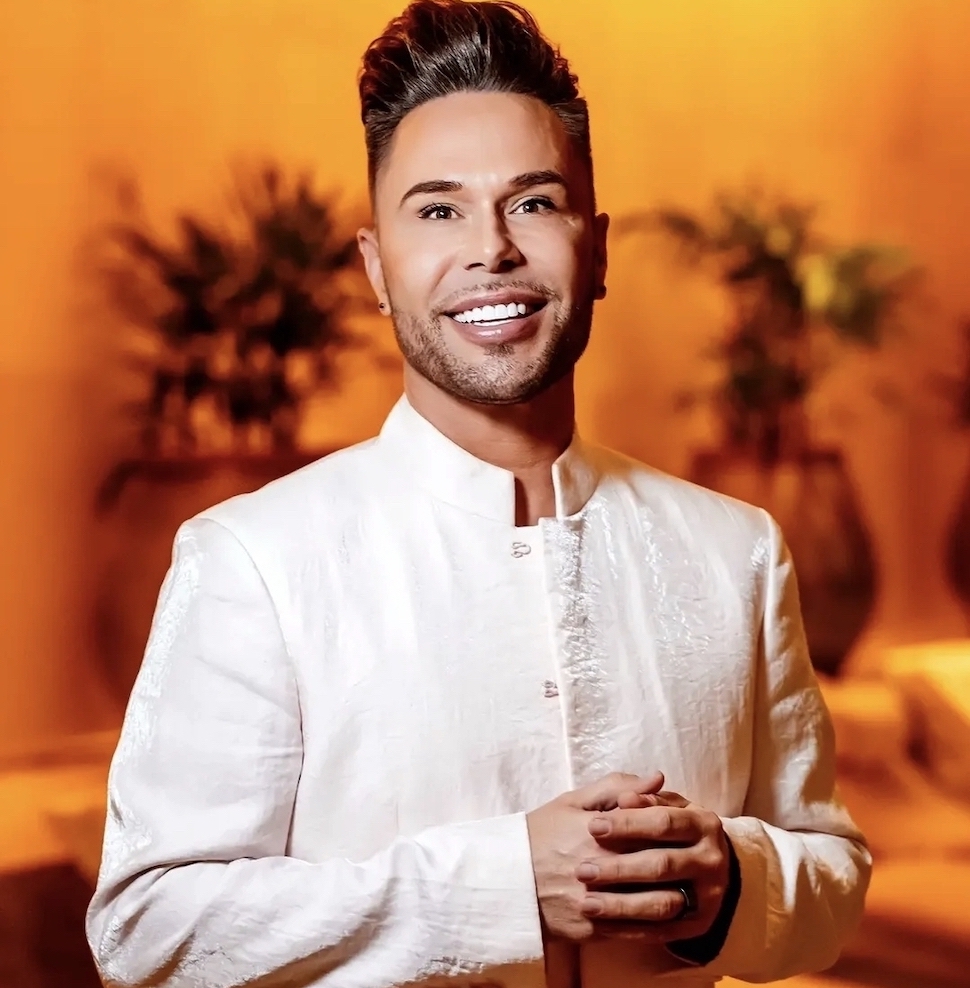
Passion Transfer Specialist. That’s his first super power. And what is that, I ask? He doesn’t mince words. “I’ve been unapologetic about who I am since I was little,” he says. A child of Vegas, Shane opened Treasure Island at 17, was Artistic Director for the World Cheerleaders Association, ran a collection of salons and day spas, broke sales records at Saks, and ran a smorgasbord of spas.
His newest act is the The SunShane Collective. Say that name aloud, and I guarantee you’ll smile. And now you really know what a Passion Transfer Specialist is.
Ever curious, I caught up with Shane to learn more.
MB: How did The Sunshane Collective come to be?
SU: I came up with it one morning, the week I was evolving out of my latest role. I woke up and thought to myself, What are the two things that light you up? What are they—and what do you want to do?
MB: I love the name, it’s so positive and upbeat.
SU: Why wouldn’t I have that positive outlook, given the people I’ve been blessed to know over the years and the great teams I’ve worked with? It’s like friendships—you want to make sure there’s alignment. The crud floats to the top and eventually floats away. What remains is a valuable core of experienced, talented people, whether in friendships, familyships, or workships.
I’ve been in hospitality for 33 years. I started right out of culinary school at 17. I opened up Treasure Island for Elaine and Steve Wynn back in 1993. I was the youngest team member working in the kitchen and cooking with individuals in their 40s and 50s who’d been doing this their whole lives. There I was 17, out of school, learning to love what was in front me.
MB: That’s beautiful—learning to love what was in front of me—and says so much about who you are. Were you born and raised in Vegas?
SU: Born in Las Vegas, raised in Carlsbad, California, and came back to Las Vegas in middle school. My family are all from Vegas. My grandfather was head of Teamsters Union, Area 51—his responsibility. We have history. My other grandpa, my mother’s father, was head of security at the Sands, back when they walked around in the rafters to monitor the gaming floor. He was in the “Black Book,” so we were always a little confused how he was allowed into that casino . . . there were ties to something unspoken.
We don’t know how to appreciate where we’re from because were so busy running away from it because it’s so familiar—then there’s a moment in your life when you realize to appreciate and honor the history. It’s a blessing to originate from a city that was so small and special.
Growing up in Carlsbad, I despised the ocean because I wasn’t in Las Vegas. I was fighting to get back to where my birth mother was. I spent so much of that time focused on getting back to where I thought I belonged. That became an analogy for life: you can spend so much time trying to get back to something that you miss where you are. Now, as a more grounded person, I can recognize that and appreciate my life in real time. You’re present in your now so you can create your future.
MB: I’m intrigued by the fact that you started your career in culinary. Why did you choose that path?
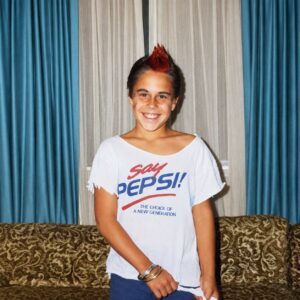
At 10 years old, this kid exuded Sunshane!
SU: As a young person I knew I was colorful and unique and I leaned more into feminine options. I was passionate about hair and makeup and Barbies, and when I went into high school, in order to avoid my feminine, I really would make selections like being on varsity soccer even though I was the lead in every theatre show on campus. I combined both my masculine and feminine sides. I thought about what I could do to support my dreams and my passions that wouldn’t be a trend that would go away.
Food is always going to be a love language for people. In selecting the programming for my vocational training, instead of going into cosmetology classes, I chose to go into culinary—it was Vegas, after all—food and beverage, hotels, that’s where the money was.
There was so much versatility in what I could do in F&B. I could always make a living no matter what collapses. I really leaned into that space. At 17 in 1993, I was making $30 an hour.
MB: So, what led you into the spa space?
SU: I was working in the kitchens and realized over the years my personality was too big for the confines of a small space. And so, with that, I went from the back of the house to the front of the house where I’d be able to wait tables and my personality would enable me to make tips. I went into leadership training in those places.
I stayed in the industry until I was 24, then I ended up working with a mentor of mine, Patti Jones. She was like a second mother, and she also owned WCA, the World Cheerleaders Association. She was a celebrity makeup artist and esthetician for Desert Inn when Steve Wynn owned it, before they knocked it down and turned it into Wynn.
Because I was personally connected to her, I would explore makeup artistry and be her assistant, go to the salon and be in those spaces with her. I’d help her personally, rather than it be my job. I’d explore and see what lit me up. I ended up being the Artistic Director for the WCA.
I’d MC the arena-style competitions, would hype these arenas of crowds before the cheerleading competition, in between cheer routines. I had to overcome my fear of crowds—I bottled that fear and used it as fuel. I was the Hype Man and the Artistic Director. Making sure the image of the organization was upheld when it came to hair, makeup, uniforms, and choreography. I guided the girls and the guys.
MB: So how did you go from being the hype man at cheerleading competitions to managing a spa?
SU: Patti had asked if I wanted to assist her at one of the salons she’d been asked to help elevate, consult on. There was a chain of them, Destination Salons and Spas.
I came in and was working the front desk, I was around 25 or 26. It was 35,000 square feet, 48 hair stations, and a small spa. It was called Destination Laguna on Tropicana and Decatur. It’s still there, different name, different iterations.
I was there for a few months promoted to manager, then ended up getting my own spa within six to eight months. I went over and ran their location on Jones and Desert Inn. Within a year, I was promoted to regional and took on two other destinations. I was very passionate and energetic, and because I wasn’t experienced, I was able to offer a different perspective to what I saw. Instead of holding on to what it should be, I was looking at it as to what it could be.
MB: You still have that super power.
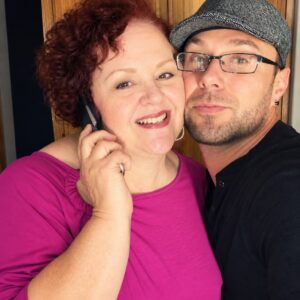
Shane with mentor Patti Jones
SU: I still do. Very, very much so.
The executive team of Saks Fifth Ave Las Vegas were clients and would come in. They were watching me and eventually approached me and said, “We’ve watched you for months, you have such energy, a smile on your face, and a positive attitude. If you want to change, we have a position in cosmetics and fragrance for you.”
I ended up becoming the Assistant Director for Saks. I was there for about three and a half years. I broke records—double digit increases in retail. We were leading our region. What was unique to the approach was that they knew how colorful I was—so they supported that and provided a blank canvas to use that color to create with.
MB: Why do you think you’ve been so lucky with people? Why have they seen you?
SU: Because I’ve been unapologetic about who I am since I was little.
MB: Where did you get that confidence?
SU: As a kid I was creating my own world to escape the bullying of the real world, of how those kids treated me. I created my own world and lived in my own space, and as I got older, I continued to carve my path because I was such a resilient gay child. That resilience and adversity created something special that I use as a super power rather than as the cross that I bear. I used it as the tool to carve my path.
MB: I’m guessing your parents were very supportive of you at a young age.
SU: My father was very supportive. He was a model back in the 70s for John Robert Powers, back when it was an agency. Besides being a UPS executive, he was also a performer. He would have costumes created; he went to the maker of the San Diego Padres chicken costume, their mascot, and had him create something unique to my dad which was known as the Rockin Rooster. It was stunning.
My father would go to the Carlsbad Street Fair and festivals, and as kids we’d go and hand out flyers to kids. He was the life of every party, even when he was himself, without the costume. So, all that to say, he was an inspiration through his example.
Rather than restricting me and telling me who I should be, he created without intention, inspiration on what I could be. His creativity was large and boundless. Why would he restrict me? So, I was given Barbies . . .
The mother who raised me was my stepmother, but to me she is mom. My parents allowed and gave me the freedom to choose. Two months before Halloween, and it was Halloween season for me—they couldn’t keep me out of that saloon-girl dress and rhinestone garter. Forcing my siblings into neighborhood performances where I was Jem and the Holograms or Barbie and the Rockers—you could guess I was the star.
I was definitely blessed. You don’t realize until you look back at it.
That resilience and adversity created something special that I use as a super power rather than as the cross that I bear. I used it as the tool to carve my path.
MB: That explains a lot. It sounds like your family gave you a wonderful foundation.
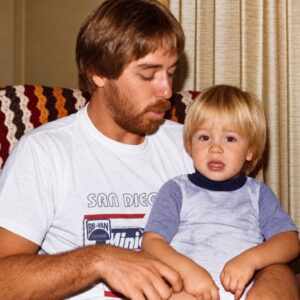
With his father Bill in 1979, at three years of age
SU: My partner at the time—I was at Saks—was someone I was with for eight years. His family were the original founders of a sandwich shop out of Delaware, and he was in Vegas helping them with their expansion. We met and got together, and he had two young daughters. As we grew together, we also helped raise two of my brother’s children for a while, so at one point we were raising four girls.
MB: That must have been an experience—kudos to you.
SU: As a person who never wanted children, it was to the point where my moral compass told me I had to. I realized I had to make a decision, to lean in and make decisions for children who couldn’t make their own decisions. I had to choose between parenting and progressing in my career—being on planes with celebrities as a makeup artist.
I chose the children and was able to discover a new joy being a parent and being a part of these young children’s origin story. I think that is when my ability to really find the joy in every single moment or every situation and circumstance occurred—that is where I discovered the rays of Sunshane.
MB: Fast forward to your entry into the spa world.
SU: After Saks, I went to the vendor side and began working for small cosmetic brands, scaling small beauty brands. At that point, I was one of the nationals and had a group of over 1,200 team members. I realized with all the travel that there wasn’t a day that I was home. I wanted to go back to working and seeing the same team every day and work on that development—growing and strengthening a certain location rather than having 43 across the country.
I saw that there was an opening at Intercontinental Resort in Century City for spa director, now Fairmont. I applied, I had no experience in the resort-style spa. But she loved my personality and resourcefulness and told me, “We love your style.”
I went right into directorship. I was in my late 20s.
MB: You had the bug.
SU: I did—and still with a fresh perspective. I didn’t attend conferences, wasn’t social in the larger spa community. I approached my business as if it were my story line of the past. Taking my experience, which was the outset of spa and applying my perspective to these locations which wasn’t the traditional same thing. I hadn’t attended an ISPA for the first five to eight years of my career.
MB: That position really paved the way for your subsequent directorships.
SU: I started at W Los Angeles, where I was so successful in building the business that I was offered the opportunity to open W South Beach, the highest grossing spa in the W portfolio at the time. While I was at W South Beach, I lost my father. Around that time, my former GM from W Los Angeles called and asked if I’d be interested in heading up the Away Spa concept at the new W Las Vegas. It was divine timing—a chance to return home to my family, with the rare opportunity to create something entirely my own, backed. by the trust and support of leadership.
My GM allowed me to create that spa with my own hands. I cut colored light covers to slip over fluorescent bulbs because they didn’t come in neon pink or chartreuse! My inspiration was a vibrant communal ultra-lounge vibe. I wanted to create a space that was social, unique, and unexpected. I took imagery originally intended for business cards and postcards, blew it up, and wrapped entire walls with it—eight-foot-by-eight-foot expanses of imagery. Walking through the spa became a sensorial experience.
I was incredibly proud of what we created. This was around 2015 to 2016.
MB: That was ahead of the curve.
SU: Because I worked in music as well, we created a transforming music journey throughout. I wanted to create a space where people who didn’t want to go to a nightclub anymore were able to gather their friends and go into an ultra-lounge type of environment. Creating every touch point and space enveloped with wellness. A spa but a communal, social experience versus shhh, shhh, shhh. The music was tribal beats, we had different stations in the rooms for clients to choose from.
That’s where the creation piece started. That property was sold, and I was offered the Diplomat Beach Resort, another iconic South Florida property. Another project that empowered and trusted me to create whatever I wanted, and I was proud to do what I did with the money I had—brass tacks—my dad taught me how to be handy.
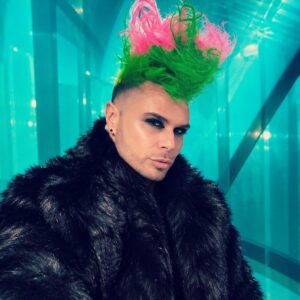
At the W Las Vegas grand opening, 2016, where Shane created the Away Spa Las Vegas
I created that legacy and then came Covid. That property closed and we waited a very long time to see if it would open back up. I realized I couldn’t stay. Hilton asked me to task force post Covid re-opening—Jessica Shea—a tremendous leader and friend, brought me over to the Waldorf Astoria Las Vegas to re-open that.
Everyone talks about doing at least one grand opening, and so Yaamava’ Resort & Casino was being created for the San Manuel tribe, and I was in conversation with them. They offered me the role of opening director. I created the spa with an abundance of money, which is amazing.
It wasn’t about profit, it’s about creating memorable experiences, and they were into it. The tribe is very community driven and pour it into their team and their local community. It really inspired me coming out of Covid even more.
I went to Yaamava’ for Serrano Spa and assembled a team of talent, working towards the goal of 5 Stars. My goal was to create a new spa concept every year for one of the highest revenue-generating casinos in the country. The goal was to give the players something fresh and new each year so it didn’t get old.
We used a ton of different brands, Naturopathica at the time—they were great partners. The blessing of that was I could use every single luxury collection I couldn’t use before because this was a casino point-driven experience, and those players want the best of the best, and we gave it to them.
MB: Which spa luxury brands did you choose to work with at Yaamava’?
SU: We ended up using Natura Bissé’s Inhibit line, Babor, Makanai, and others. I literally had 12 brands in a 500-square-foot space. We’d have featured brands come in during the player event and we’d do between $100,000 and $200,000 in four hours. We had food and beverage elements, theatrics—we were heavily focused on elevated guest experiences.
On our first Forbes shop we got Five Stars—the hotel didn’t get them, the restaurant didn’t get them—the spa got them. The team committed their heart and soul to this goal. I will forever be so proud of them.
The first Friday in February I hosted a video conference with my whole team for the ones who weren’t there in person, and I announced the Forbes Five Stars. Everyone was very emotional. At this point, I knew I was going to Fontainebleau Miami—and I told my team it was my last day, which made it even more emotional.
MB: Tell me about the Fontainebleau Miami transition.
SU: I applied for the Assistant Director of Spa for Fontainebleau Miami Beach. I interviewed for that role because the previous director had been there for 17 years. I didn’t think there was a chance she’d be leaving, so why not apply for assistant director.
I met with everyone, the executive team, and three days later went into another interview. I started my interview process a week before, and on Monday, I met with them on camera, and asked how this existing director would feel about collaboration with me, and they told me she was no longer with the company and they wanted me for the position.
I had flown out and done all of the interview process, there was one another candidate, but that didn’t worry me. I showed up in my hunter-green skintight satin suit with black heels and a Louis Vuitton backpack, a silver Louis Vuitton backpack with my laptop ready for my presentation. I had prepared to assume my role.
During Covid, my mentor and another good friend Megan Linney and I went to visit the Fontainebleau Miami. As we walked the spa entry and retail space, I said to her, “This will be my spa someday.” Cut to the moment after my in-person interviews—it was early evening and Eric Segreti, the VP of Hotel Operations, asked me to come down and chat in the hotel lobby. What initially sounded like a “Thank you for your time, but no thank you,” ended up with an offer for me to be the second-ever appointed spa director in the history of Fontainebleau Miami Beach. He smiled at me and emotion took over, and I cried in that lobby. I will never forget it.
I started on Feb 4th, 2023.
MB: And the rest is history.
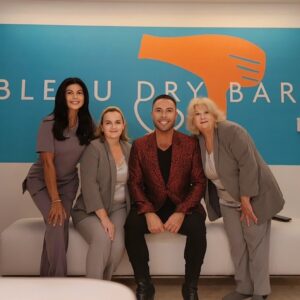
The Fontainebleau Miami days
SU: I was hired as the spa director and realized within six months how impactful I was. They created an Executive Director of Spa and Wellness role for me. By the end, I became Leader of the Year. I broke records—highest revenue of 18 years with a 43 percent profit margin which was insane. This success and dedication led to me being the first-ever appointed Vice President of Spas and Wellness for Fontainebleau Miami and Las Vegas.
MB: You have the magic touch. After your tenure with Fontainebleau, you conjured The Sunshane Collective. Let’s talk about that. Why the name?
SU: When you think of collective, it screams community. It’s not so corporate, collective is more artistic, communal, community. I wanted it to feel more textural and more layered rather than corporate.
MB: So, what exactly is it all about?
SU: Over the years, I became the person people turned to for my straightforward approach and my unwillingness to sugarcoat the truth. They’d ask my opinion about something, a specific brand or business, and they got my passion transfer response. The money wasn’t at the forefront of my mind, I was exchanging energy with likeminded people. I’ve never been inspired by money, always believe it starts with the people, and that will naturally create results.
Over the years, I’ve met a collection of people who were icons in the industry, and I’ve always called myself the bridge, the connector. Now was the time to grab that, to secure it and make this Sunshane Collective with hospitality superheroes with whom I would collaborate and create.
I’m the name on the company that brings the experts together to collaborate and create. I don’t want credit for your work, but I do want to bring great talent together. The relationship originates from me, but carries on a legacy through their relationships together.
MB: What do you hope it does for the industry?
SU: Everything. It is the one stop shop for any solution needed for any silo of business—restaurant, nightlife, design, spa and wellness, residential, private club, and all encompassed hospitality operations. The plethora of information I have from that story of my childhood and up—applying all that knowledge that is genuine and authentic to my brand, I have so much to give wih my knowledge and experiences, I’ve earned the respect and admiration of my colleagues.
So now I get to introduce the other superheroes to the rest of these relationships. What a super power! Pick one—what obstacle or what resistance are you experiencing? I have something or someone for every single category, and they are skilled experts in the industry. These are people with resumes and legacy of work that will add value to my brand and to the projects we’re working on. Nothing is too big or too small—from a bathroom to a ballroom.
Instead of holding on to what it should be, I was looking at it as to what it could be.
MB: Let’s talk about our biggest challenges and what we are missing in spa right now.
SU: We’re outpacing ourselves. One of the biggest oversights I see in business, these properties, if you’re talking about spas and treatment rooms, takes 50 to 60 percent of profit market. We’re not talking about what programming we can offer outside of the treatment room which will drive the profit to our bottom line.
GMs and VPs are all “treatments, treatments, treatments!” What we’ve seen in the industry is everything is leaning toward fitness and recovery now—these spaces are creating the spas within it and now these commune community given fitness activations are in demand. The properties aren’t tuning into the potential of creating similar experiences in those spaces outside of the home base of Lifetime Fitness or Equinox.
We can create similar journeys in our spaces, but they’re not tuning into that yet. But they will. Using your ballroom, nightclub, and outdoor spaces for wellness festivals, for example. It’s coming, and it’s all fitness, longevity, and recovery. It’s not facials and massages, yes, those will always be something, but if you’re really watching where the general population is really tuning in you’d see it—but most people are in their glass offices in the sky.
If we continue to be resistant to change, we’re never going to be what we’re meant to be.
MB: What does it take for a spa to develop a strong, recognizable identity—and stay true to it?
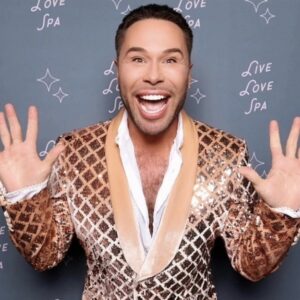 SU: Identify the pillars of who you are as a spa and anchor those. Every choice you make goes back to those pillars and it has the guest being able to identify the experience and the way they feel in those spaces. If it’s piecemealed together and doesn’t align with the pillars it becomes diluted and confusing. I have great admiration for Mandarin Oriental, they’re known for their rituals. Every decision they’ve made goes back to their four pillars.
If spas are chasing trends outside of their identity, “I’ll do a GLP facial or a Longevity manicure,”— it’s not going to work. Strip it down, identify what it is, and then create from there and get the buy-in from the team. It has to be a lifestyle and a culture. You have to live it every day.
MB: We’re at such a crossroads now . . .
SU: It takes the rays of Sunshane to light up the path for the future. If you’re always looking to the past, then you are missing everything that is in front of you. The potential and the possibilities. Your potential and your possibilities.
MB: What’s your parting piece of wisdom for my readers?
SU: No matter who you are, what you do, understand that your talent, your experience, and your background are signature to you. Trust in the foundation and own your knowledge as if it were the foundation from which you speak when you walk into a room. Own the fact that nobody can do what you do. Be who you are and gift who you are to this world. Incomparable. You are the gift. Own your voice.
Mary Bemis
A pioneering voice in spa and wellness journalism, Mary Bemis has spent four decades chronicling, championing, and helping shape the modern spa industry. As Founder and Editorial Director of Insider’s Guide to Spas, she brings a distinctive editorial perspective informed by a career that has helped define the language and landscape of spa media. Mary launched American Spa magazine in 1997, co-founded Organic Spa, and helped launch Luxury SpaFinder and NewBeauty. Her industry leadership extends to board service with ISPA, NYSPA, and WSPA, the latter two organizations she helped establish. She has also served as Special Advisor to the Balneology Association of North America. Today, she serves as Special Advisor to Global Wellness Day and sits on the board of the International Sauna Aid Foundation. Recognized among Medika Life’s Top 30 Influential Voices Transforming Wellness, Mary is also a recipient of the prestigious ISPA Dedicated Contributor Award, an inaugural Folio Top Women in Media honoree, and an American Spa Wonder Woman of Wellness. Her mission remains as steadfast as ever: to keep spa culture alive and relevant, honor its roots, challenge its shortcomings, and inspire an industry to live up to its promise.
- Web |
- More Posts(91)